AI in Social Care
Does AI Replace Care Staff, or Can People and AI Work Together?
AI can reduce repetitive administration and surface useful information, but human judgement, relationships and accountability remain central to care.
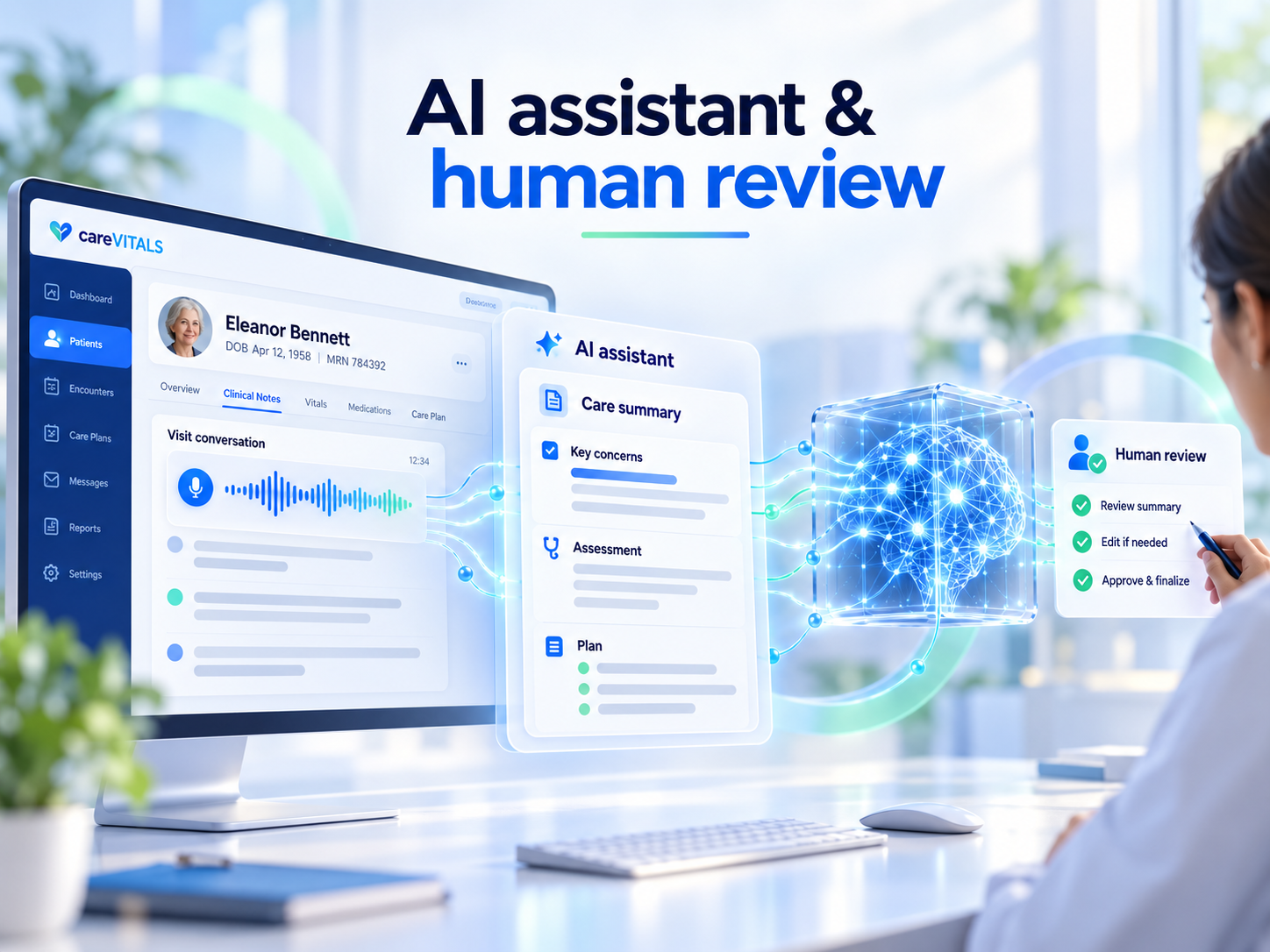
Artificial intelligence is becoming more visible across health and social care. That naturally raises a question: will AI replace care staff, or can it help people do their jobs better?
In social care, the most useful role for AI is not to replace the human relationship. It is to reduce repetitive administration, make information easier to understand and help staff focus attention where it is most needed.
Care is fundamentally human
Care depends on trust, empathy, judgement, communication and relationships. A care worker notices how somebody looks when they answer the door, whether their mood is different, whether they are moving differently and whether something they say needs sensitive follow-up. Technology can support those observations, but it cannot replace the relationship in which they happen.
For that reason, careVITALS sees AI as a support tool: technology that works alongside operational and frontline staff rather than replacing them.
Where AI can save time
Care services create a large amount of information. Staff write care notes, managers prepare KPI reports, quality teams review incidents, supervisors check documentation and office teams search records for relevant history.
AI can help with some of this administrative workload. Examples include summarising long records, identifying themes across notes, helping draft clearer management information, extracting key points from structured data and supporting faster preparation of reports.
AI-assisted care notes - with human review
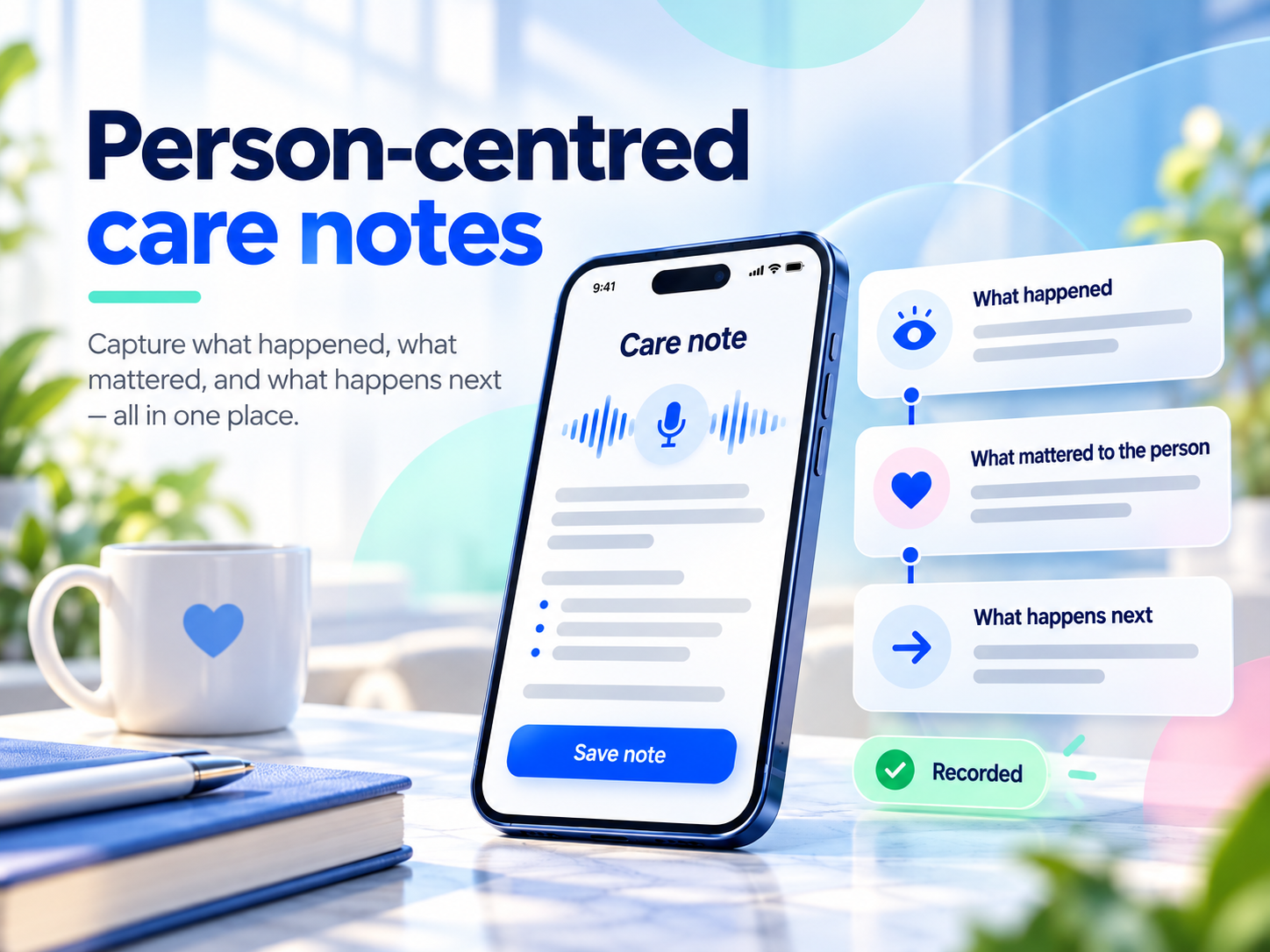
AI can help turn dictated or structured information into a clearer draft care note. This can reduce typing and help staff capture more complete information. However, the care worker should remain responsible for checking that the final note is accurate and reflects what actually happened.
The principle should be simple: AI may assist with the wording, but it should not invent clinical facts, make unsupported assumptions or remove professional accountability.
Faster KPI and management reporting
One of the most practical uses of AI is helping managers make sense of large amounts of operational information. Instead of manually reading hundreds of records, AI can support summaries and trend identification across areas such as care delivery, incidents, medication, documentation or other KPIs.
This can help a manager decide where to investigate further. The final judgement and action still belongs to the service.
Using AI to identify patterns, not make unchecked decisions
AI may help highlight changes or patterns that a human team should review. For example, repeated references to poor appetite, increased assistance, missed medication or a change in mobility may justify closer attention.
The safe use of AI is to support prioritisation and review - not to allow an algorithm to make important care decisions without appropriate human oversight.
AI works best with good digital data
AI is only as useful as the information available to it. If care records are incomplete, inconsistent or spread across paper, spreadsheets and different applications, AI will have a limited view.
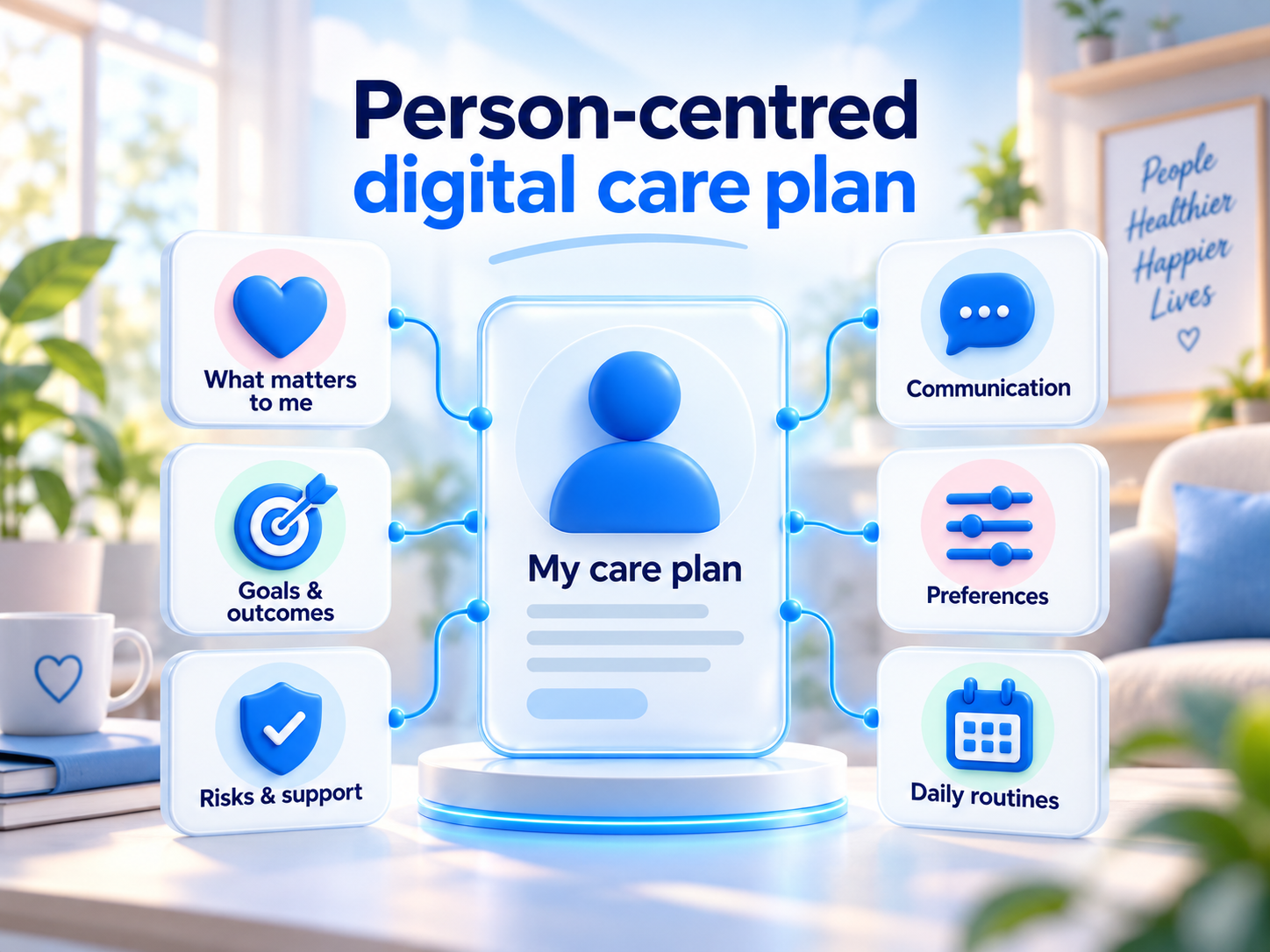
This is one reason digital care planning, mobile care notes, structured assessments, medication management and connected KPI data matter. Strong digital foundations make it easier to use AI responsibly and meaningfully.
Virtual care and connected devices add another layer
AI can also work with information from sensors, monitoring devices and virtual care technology. Changes in observations or patterns may help teams identify where a person needs review between scheduled visits.
Again, the value comes from combining technology with professional judgement, clear escalation pathways and the person's consent and preferences.
The question should not be "How many people can AI replace?" It should be "Which low-value administrative tasks can technology reduce so staff can spend more time on people and quality?"
Responsible AI requires governance
Providers using AI should consider data protection, security, access controls, transparency, human review and how errors are managed. Staff also need to understand when they are using an AI-supported function and what they remain accountable for.
AI-generated content should be treated as assistance, not an unquestionable source of truth.
What this means for the care workforce
Used well, AI can change parts of a role without removing the need for the role itself. A supervisor may spend less time compiling reports and more time coaching staff. A care worker may spend less time typing and more time interacting with the person. A registered manager may get earlier visibility of a trend instead of finding it during a monthly audit.
How careVITALS approaches AI
careVITALS is developing AI tools as part of a wider care management platform, alongside digital care planning, rostering, medication management, mobile applications, KPI reporting and virtual care. The focus is to support care teams with information and administration while keeping people responsible for the care, decisions and relationships.
The future of social care is unlikely to be people or technology. The stronger model is people supported by better technology.
Other Insights

Book a Free Demonstration
Want to see practical AI tools designed to support care teams rather than replace them? Book a careVITALS demonstration.